
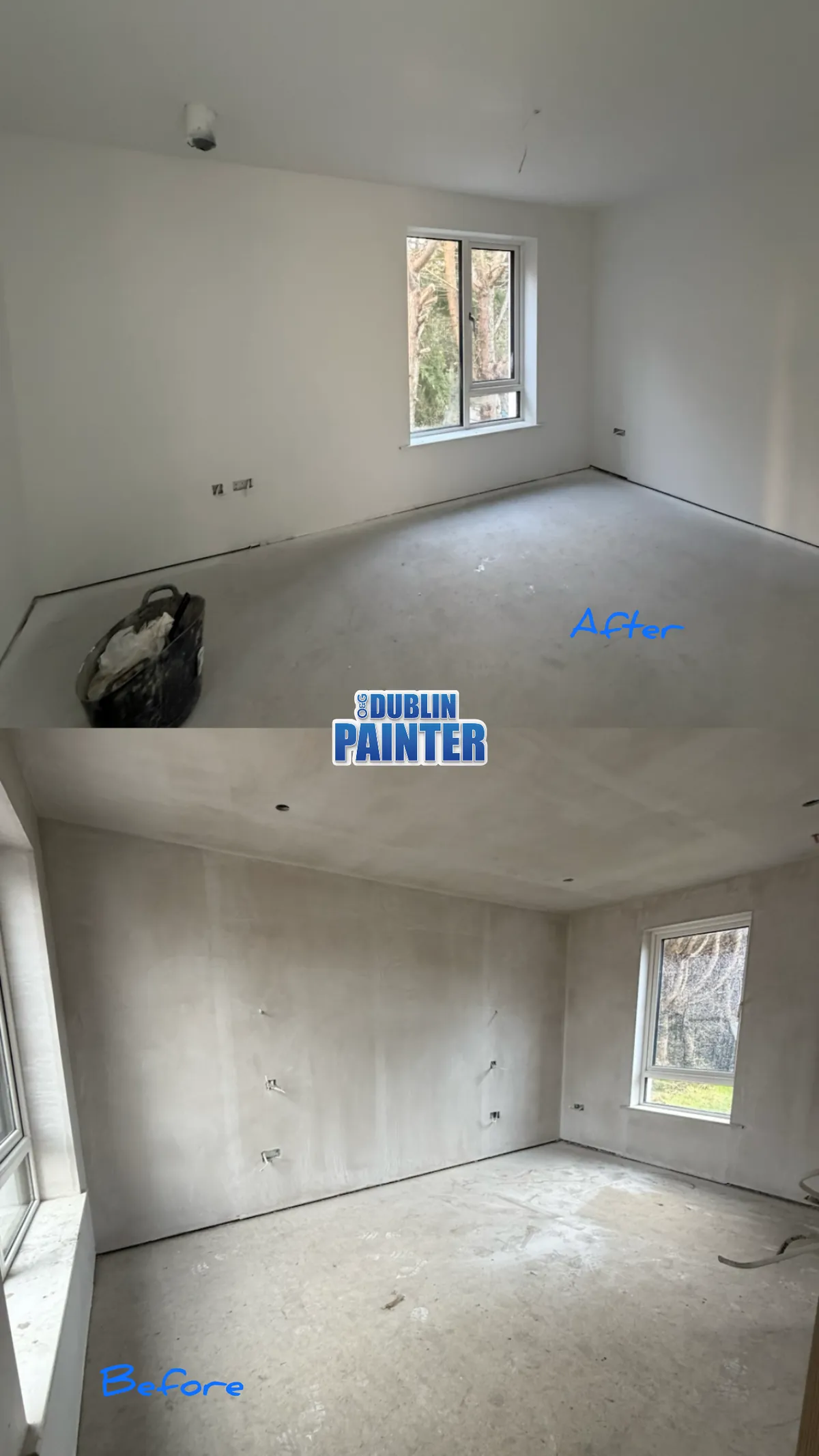
Cracked ceilings, tired old walls, or fresh stud partitions that need a smooth face before a lick of paint? Plastering is the foundation every good paint job sits on, and a poor skim shows through no matter how careful the decorating that follows. At Original Dublin Painter, Alex and his team bring 20+ years’ experience to plastering across Dublin, delivering flat, durable, paint-ready surfaces on both homes and commercial premises. Rated 4.9 stars from 159 Google reviews and fully guaranteed, we handle the messy, skilled work that makes the finish look effortless — tidy, on time, and with a free, no-obligation on-site quote before we start.
What our plastering service covers
Plastering is more than trowelling on a bit of mix. Depending on the state of your walls, the right job might be a quick refresh or a full re-line. We cover:
- Skimming — a thin, smooth top coat over existing plaster or plasterboard to erase old textures, patch repairs and hairline cracks, leaving a flat surface ready for paint.
- Plasterboarding (dry lining) — fixing new boards to studwork, ceilings or battened walls, then taping the joints and skimming over the top so no joints show.
- Ceiling repairs and re-skimming — flattening artex, cracked or sagging ceilings back to a clean, modern finish.
- Patch plastering and crack repair — cutting out and making good damaged areas, filling voids, and blending them invisibly into the surrounding wall.
- Full room and whole-house plastering — from a single feature wall to a top-to-bottom renovation or extension.
- Feature and decorative finishes — smooth render, coving preparation and clean corners that set off the room.
On a residential makeover or a commercial renovation alike, we use quality materials and current techniques to give you a smooth, hard-wearing finish that lifts both the look and the value of the space.
Plaster repairs: cracks, blown plaster and old ceilings
A lot of what we’re called out for isn’t a full re-skim at all, it’s repair. Typical plaster repair jobs around Dublin include:
- Cracks around door frames, window reveals and ceiling joints, raked out, filled and taped where needed so they don’t come straight back.
- Blown or hollow plaster that sounds drummy when you tap it. It has to be cut back to sound plaster and made good, or new paint and paper will keep coming away.
- Damage after other trades: holes and chases left by electricians, plumbers or a new kitchen fit.
- Old lath-and-plaster ceilings in period houses, where sagging or cracked sections are repaired or overboarded and skimmed.
- Artex ceilings and textured walls, skimmed over to a flat, modern finish.
Small repairs are often done in the same visit as the decorating, so you don’t need a separate plasterer, wait for them, and then bring the painter back.
Plasterers and decorators: one team, start to finish
Most plastering jobs end with paint, and that’s where a lot of projects lose time: the plasterer finishes, the walls dry, and then you’re chasing a decorator. Because we do both, we plan the skim and the paint as one job, mist-coat the new plaster properly once it’s dry, and hand you back a finished room. One quote, one team, and no arguing between trades about whose fault a crack is.
Meticulous preparation for a flawless finish
The difference between plaster that lasts and plaster that cracks is almost always the prep. We never rush this stage. Every job starts with a careful groundwork routine:
- Thorough assessment — we inspect your walls and ceilings for damp, movement, loose plaster or old coatings that could affect adhesion, and agree the right approach before any material goes up.
- Surface preparation — surfaces are cleaned, dust removed and, where needed, sealed or PVA’d so the new plaster grips properly and dries evenly.
- Protecting your space — floors, skirting and furniture are covered and masked off. Plastering is a dusty trade, and we keep it contained so you get your rooms back clean.
- Quality control — the correct tools, mixes and timings for each stage, so what we hand over is genuinely flat, smooth and ready for the decorator — often us.
Because we also handle the interior painting afterwards, we prep every surface knowing exactly what a paint finish demands — no shortcuts that come back to haunt the topcoat.
Why choose Original Dublin Painter for plastering
We stand out on the fundamentals that actually matter to a homeowner living through the work:
- Experienced craftsmanship — Alex leads a skilled team with two decades of plastering and decorating behind them, so tricky ceilings, old lath-and-plaster and awkward corners are routine, not a gamble.
- Quality materials — we use dependable, proven products for a durable, good-looking finish that stays put.
- Tidy and respectful — dust-sheeted, masked-off and cleaned down at the end of every day; our reviews mention our tidiness again and again.
- Reliable and on budget — we turn up when we say, work to the agreed timeline, and there are no surprise costs bolted on at the end.
- Fair, transparent quotes — a free on-site assessment means an accurate price for your actual room, not a vague phone estimate.
- Fully guaranteed — every job is backed by our workmanship guarantee, for genuine peace of mind.
Once the plaster is dry, we can take the project straight through to a finished, painted room — from interior painting to exterior painting and even house painting across the whole property. One trusted team, start to finish. Your vision, brilliantly brought to life.
What affects the cost of plastering?
There is no single flat rate, because no two walls are in the same state. The main factors are:
| Factor | Effect on price |
|---|---|
| Area size | A single wall or patch costs far less than a full room or ceiling. |
| Skim vs. board-and-skim | Plasterboarding before skimming adds materials and labour over a straight skim. |
| Surface condition | Damp, large cracks, void filling or removing old artex all add prep time. |
| Access and height | Stairwells, high ceilings and tight rooms take longer to set up safely. |
| Number of coats and finish | Extra making-good or a very high-end finish increases the time on site. |
As a guide, our house painting cost guide puts plastering and skimming at around €25 to €40 per square metre in Dublin, with minor wall repairs from €80 to €150 per room. The only way to price your job fairly is to see it. We give an accurate figure after a quick on-site assessment — get a free quote and we will talk you through exactly what your walls need.
Areas we serve
As a service-area business, we bring our plastering and decorating right to your door across all of Co. Dublin — including Howth — and out into Kildare, Meath, and parts of Wicklow and Co. Louth. If you are within reach of Dublin, we can quote your plastering job.
FAQs
What determines the cost of plastering a room?
It comes down to the size of the area, the complexity of the work and any extras your walls need. Plastering a single wall or patch is much cheaper than a whole room, and if surfaces need plasterboarding before skimming, the added materials and labour raise the price. The only way to get an accurate figure is an on-site assessment — which we do free of charge.
How much does a plasterer charge in Ireland?
In Dublin, skimming typically works out at around €25 to €40 per square metre, depending on the condition of the wall, access and whether it needs boarding first. Small patch repairs are usually priced per job rather than per metre. We give a fixed price after a free on-site look, so there’s no day-rate guesswork.
Can I plaster over old plaster?
Usually, yes, provided the old plaster is sound. We check it first: anything loose, hollow or blown is cut out and made good, the surface is cleaned and sealed with a bonding agent so the new skim grips, and then the whole wall is skimmed. Plastering over plaster that’s already coming away just traps the problem underneath.
Can you skim over artex?
Yes. Artex ceilings and textured walls can be skimmed to a smooth finish. Older artex can contain asbestos, so if it went up before the 2000s, get a sample tested before anyone sands or scrapes it. Once it’s cleared, the surface is cleaned, any loose texture knocked back, a bonding coat applied, and then skimmed.
How long does plaster take to dry?
Fresh plaster typically dries in around 3–5 days, but conditions matter. Thickness, room temperature and ventilation all play a part. Areas that needed extra work — filling large cracks or voids — can take up to two weeks to dry fully. Keep the room at a moderate temperature with a little airflow; too much heat can cause cracking or hazing.
How can I tell when the plaster is dry?
Watch the colour. Newly applied plaster is dark brown from its moisture. As it dries it goes patchy, mixing brown and pink, and once it is fully cured it turns an even pale pink. Corners and thicker patches dry last, so it is only truly dry when every brown patch has gone and the whole surface is a uniform pale pink.
When can I paint over newly skimmed walls?
Wait until the plaster is thoroughly dry — usually a minimum of 3–5 days, sometimes longer in cooler or less ventilated rooms. The wall is ready to paint once it has turned that even pale pink with no remaining brown patches. Rushing paint onto damp plaster traps moisture and causes peeling later, so it is worth the wait — and it is one reason clients like having the same team plaster and then paint.


